
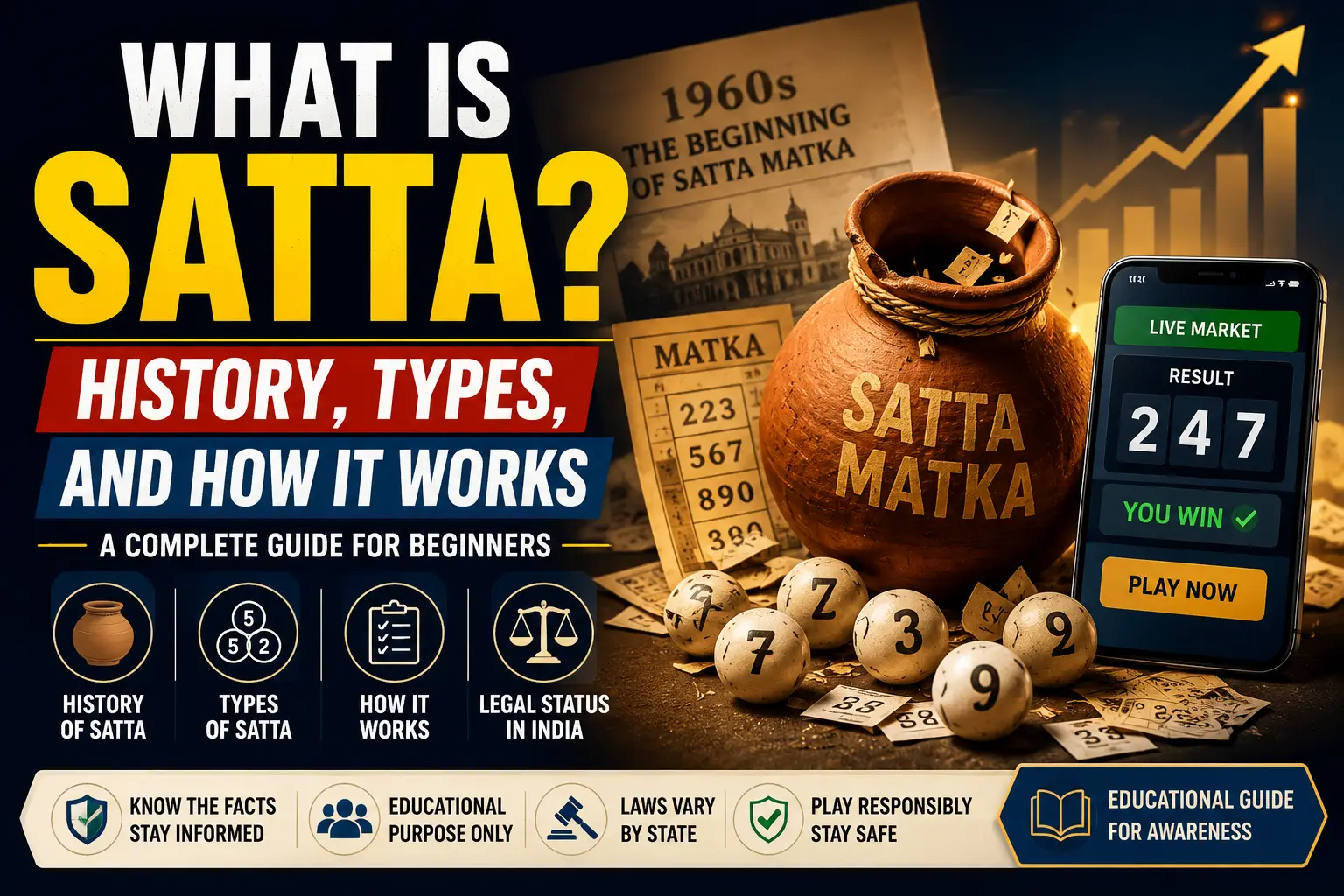
Introduction
If you’ve spent any time browsing Indian news archives, old Bollywood films, or conversations about underground betting networks, chances are you’ve come across the term “Satta Matka.” It’s a phrase that carries decades of cultural weight in India, yet many people who hear it today have only a vague idea of what it actually refers to.
So, what is Satta Matka, really? In simple terms, it’s a form of illegal betting that originated in Mumbai several decades ago and evolved into one of the most well-known underground gambling networks in Indian history. This article breaks down its meaning, traces its origins, explains its current legal status, and separates fact from myth — purely from an informational and historical standpoint.
Whether you’re researching this topic out of curiosity, writing about India’s gambling laws, or simply trying to understand a term you’ve heard in passing, this guide covers what you need to know.
What Does “Satta Matka” Mean?
The term “Satta Matka” is a combination of two Hindi words:
- Satta — meaning “betting” or “gambling”
- Matka — meaning “earthen pot”
Together, the phrase roughly translates to “betting on the pot,” a reference to the original method used to conduct the activity. In its earliest form, numbers were physically drawn from a matka (clay pot), which gave the practice its distinctive name.
Over time, “Satta Matka” became a blanket term for a specific style of numbers-based betting that spread across parts of India, even as the actual method of conducting it changed dramatically.
A common misconception is that “Satta Matka” refers to a lottery. While there are some superficial similarities, Satta Matka has historically operated as an unregulated, illegal betting network — a key distinction from state-run or licensed lotteries, which are legal in select Indian states.
The Origin & History of Satta Matka
Cotton Rates and the New York Cotton Exchange
The roots of Satta Matka trace back to the 1950s in Mumbai (then Bombay), and interestingly, its origins had nothing to do with numbers drawn from a pot. The earliest version involved betting on the opening and closing rates of cotton transmitted via telegraph from the New York Cotton Exchange.
Local traders and mill workers would place informal bets on the fluctuation of these rates. This practice became popular among Mumbai’s massive textile mill workforce, who were looking for ways to supplement modest incomes during that era.
The Shift to Number-Based Betting
In 1961, when the New York Cotton Exchange stopped transmitting rates in the format that had been used for betting, the practice needed a new system to survive. This led to the creation of a number-based format, where participants would bet on numbers drawn from a matka.
This shift marked the beginning of Satta Matka as it’s more commonly recognized today — a numbers game rather than a commodity-rate betting system.
Growth Through the Decades
Through the 1960s, 70s, and 80s, Satta Matka expanded significantly, particularly in Mumbai and other urban centers. It operated through informal networks of bookies and operators, with information passed through word of mouth, phone calls, and eventually printed result sheets.
Several networks and variations emerged during this period, each competing for a share of the underground betting economy. As law enforcement scrutiny increased in the 1990s and 2000s, much of this activity was pushed further underground or migrated toward newer formats — including phone-based betting and, eventually, unregulated online platforms.
How the Traditional Format Worked (Historical Overview)
Historically, the process involved participants selecting numbers, with results eventually announced by operators at scheduled times. It functioned as an informal, decentralized network rather than any single organized business — meaning there was no regulatory oversight, no consumer protection, and no legal recourse for participants who lost money or were defrauded.
This lack of structure is part of what allowed Satta Matka to persist for decades despite legal risk: enforcement against a diffuse, informal network is inherently more difficult than targeting a single organized entity.
It’s worth noting that this section is provided strictly for historical and educational context. Detailed mechanics of how bets were placed or numbers selected are not covered here, as the practice remains illegal in India.
Legal Status of Satta Matka in India
This is arguably the most important part of understanding Satta Matka today: it is illegal across the vast majority of India.
The Public Gambling Act, 1867
India’s primary gambling legislation, the Public Gambling Act of 1867, predates independence but still forms the legal backbone for anti-gambling enforcement in many states. Under this law, operating or visiting a “common gaming house” is a punishable offense. Satta Matka operations are treated as falling under this prohibition.
State-Level Variations
Gambling regulation in India is largely a state subject, meaning individual states can pass their own laws. Some states have stricter frameworks than others, and a few (like Goa and Sikkim) have carved out limited legal exceptions for specific forms of gambling — but Satta Matka is not among the activities legalized in these exceptions.
In most Indian states, participating in or operating a Satta Matka network can lead to:
- Fines, which vary by state and severity of involvement
- Imprisonment, particularly for operators, bookies, and repeat offenders
- Asset seizure in cases involving organized networks
Lottery vs. Satta Matka: An Important Distinction
It’s worth clarifying that government-run lotteries are legal in certain Indian states (such as Kerala, Punjab, and a few others) under specific regulatory frameworks. Satta Matka is fundamentally different — it has never been a licensed or regulated activity anywhere in India, which is why it remains classified as illegal betting rather than a legal gaming option.
The Online Gray Area
In recent years, numerous websites and apps claiming to offer “Satta Matka results,” predictions, or participation have appeared online. It’s important to understand that:
- These platforms operate in a legally ambiguous and high-risk space
- Many are based outside India specifically to evade domestic law enforcement
- Participation still carries legal risk for users within India, depending on state law
- A significant number of these platforms are associated with scams and fraud, with no accountability for lost funds
Why Satta Matka Persists Despite Being Illegal
Understanding why an illegal practice has survived for over 70 years requires looking at a few contributing factors:
- Socioeconomic pressure — In communities facing financial hardship, the appeal of quick, high-reward outcomes can be difficult to counter through enforcement alone.
- Decentralized networks — Without a central organization to dismantle, authorities face an ongoing challenge in fully eradicating the practice.
- Migration online — As physical operations became harder to sustain, much of the activity moved to phone and internet-based formats, complicating jurisdiction and enforcement further.
- Cultural familiarity — Decades of exposure through media and word-of-mouth have normalized the term, even among people who don’t participate.
Risks & Consequences
Beyond the legal risks outlined above, participation in Satta Matka — historically and in its current online forms — carries several serious risks:
- Financial loss: Like most unregulated betting systems, the odds are structured to favor operators, and there’s no guarantee of fair play.
- Debt and financial distress: Many documented cases involve individuals accumulating significant debt while chasing losses.
- Fraud: Especially online, many platforms disappear after collecting funds, with no legal recourse for victims.
- Legal jeopardy: Even indirect involvement (facilitating, hosting, or promoting) can carry criminal liability under Indian law.
- Social and psychological impact: Gambling-related financial stress has well-documented effects on mental health and family stability.
Satta Matka in Pop Culture & Media
Given its long history, it’s no surprise that Satta Matka has made its way into Indian films, documentaries, and literature. It’s often portrayed as part of Mumbai’s underworld history, tied to broader narratives about organized crime, urban poverty, and the informal economy of the mid-20th century.
This portrayal has contributed to the term’s lasting recognition — many people today know the phrase “Satta Matka” primarily through cultural references rather than firsthand knowledge of how it operated.
Common Myths vs. Facts
| Myth | Fact |
|---|---|
| Satta Matka is a legal form of lottery | It is illegal in nearly all Indian states and is legally distinct from licensed lotteries |
| Online Satta Matka platforms are safe | Most operate outside legal oversight and carry significant fraud risk |
| Only operators face legal consequences | Participants can also face fines or prosecution under state gambling laws |
| Satta Matka has “official” results | There is no legitimate, government-recognized authority behind any results published online |
| It’s a modern online-only phenomenon | Its roots trace back to 1950s Mumbai and physical betting on cotton rates |
Conclusion
So, what is Satta Matka? At its core, it’s a decades-old, illegal betting practice that originated from cotton rate speculation in 1950s Mumbai and evolved into a numbers-based underground gambling network. While it holds a notable place in India’s cultural and historical narrative, it’s important to recognize that Satta Matka remains illegal under the Public Gambling Act, 1867, and various state laws — with real legal, financial, and personal risks for anyone involved, including through today’s online platforms like Nammasarkara.
This article is intended purely for informational and educational purposes. It does not endorse, promote, or provide guidance on participating in Satta Matka or any related betting activity in any form.
If you’re interested in related topics, consider exploring the history of gambling legislation in India or how state-run lotteries are regulated — both offer useful context for understanding India’s broader approach to gaming law.
People Also Read: How to Bet on Cricket: Complete Beginner’s Guide (2026)